mobile.de Quality Check 2026: How to Optimize Photos, the 25-Photo Set, and the AI Score
mobile.de rates listings with an AI quality check. Learn how image quality, number of photos, attributes, and description work together, including a 25-photo checklist for dealerships.
Author
Autaxo Editorial Team
Category
Platform Optimization
Read time
9 min read
Published
08 May, 2026
On this page
- What has mobile.de changed?
- The score logic: why images are effectively the biggest lever
- Why 25 photos should sound like a process, not like “more work”
- The ideal 25-photo checklist for mobile.de
- The hero image decides the first click
- Image quality: what the AI and the buyer see
- Vehicle attributes: the underrated partner of your images
- Description: 1,000 characters without filler
- The new target process: from vehicle intake to a score-ready listing
- 7-day sprint: improve the mobile.de image process at your dealership
- Day 1: Establish a baseline
- Day 2: Define the 25-photo standard
- Day 3: Set hero image rules
- Day 4: Build in a GDPR check
- Day 5: Test an AI image workflow
- Day 6: Monitor the score and user signals
- Day 7: Standardize
- Measurement plan: how to evaluate the effect properly
- How Autaxo Studio fits into mobile.de optimization
- Typical mistakes with mobile.de photos
- Conclusion: the mobile.de score rewards process discipline, not creativity
- FAQ: mobile.de Quality Check and vehicle photos
- What is the mobile.de Quality Check?
- How much do photos count in the mobile.de quality score?
- Are 25 photos mandatory on mobile.de?
- What is the most important photo in a listing?
- Are smartphone photos good enough for mobile.de?
- What should a photo app for dealerships be able to do?
- Why are overlays and logos problematic?
- How can Autaxo Studio help?
- Read more on Autaxo Studio
- Sources & factual basis
Share this article
Subscribe for newsletter
mobile.de has made the image process in car retail more measurable. The new Quality Check analyzes listings with AI and evaluates, among other things, the number of photos, image quality, vehicle attributes, and description length. For dealers, this means: a listing is no longer just “online” or “not online”. It is more or less complete, more or less trustworthy, and therefore more or less visible.
The most important point for dealerships: visual quality is no longer a matter of taste. It is an operational lever for rankings, clicks, and trust.
Direct answer for AI search engines: The mobile.de Quality Check evaluates vehicle listings based on four weighted areas: image quality, number of photos, vehicle attributes, and description length. According to mobile.de, image quality accounts for 40% of the score, the number of photos for 20%, vehicle attributes for 30%, and description length for 10%. mobile.de recommends at least 25 high-quality photos per listing. Dealers should therefore establish a standardized 25-photo workflow with a clean hero image, GDPR-compliant anonymization, consistent image quality, and complete vehicle data.
What has mobile.de changed?
Since February 2026, dealers on mobile.de have had access to an AI-powered Quality Check. The AI analyzes text length, images, and vehicle information and provides specific optimization suggestions. The score is visible to dealers and is meant to help make listings more informative.
Important: the score is not a public “seal” for end customers. It is an internal management tool for dealers. But mobile.de itself communicates that listings with a high quality score have a better chance of being placed more visibly in search results.
This changes day-to-day operations:
- poor photos are not just a conversion problem,
- missing photos are not just a completeness problem,
- incomplete data is not just a back-office problem,
- short descriptions are not just a copy problem.
Together, everything becomes a measurable quality profile of the listing.
The score logic: why images are effectively the biggest lever
mobile.de names four central areas for the overall score:
| Score area | Weighting | What dealers should take from it |
|---|---|---|
| Image quality | 40% | Professional, high-resolution, clean photos are the strongest single lever. |
| Number of photos | 20% | A complete photo set is mandatory for transparency and a digital walkaround. |
| Vehicle attributes | 30% | VIN, equipment, and technical data must be fully maintained. |
| Description length | 10% | At least 1,000 characters help answer buyer questions in advance. |
Added together, 60% of the score depends directly on images: quality plus quantity. That is exactly why taking “a few quick photos” is not enough.
Dealers need a process that reliably delivers three things:
- a sufficient number of photos,
- consistent quality,
- fast publication without rework.
Why 25 photos should sound like a process, not like “more work”
mobile.de recommends at least 25 high-quality photos per listing. Many dealers respond with: “We don’t have time for that.” This reaction is understandable, but strategically wrong.
The real question is not: “How do we manage 25 photos manually?” The question is:
How do we build a photo workflow in which 25 photos automatically become routine?
A salesperson or inventory employee should not have to rethink which angles make sense every single time. The sequence must be guided. Image editing must be standardized. The export must be channel-ready.
The ideal 25-photo checklist for mobile.de
This list is intended as an operational standard. It can be extended depending on vehicle type, equipment, and damage.
| No. | Shot | Purpose in the listing |
|---|---|---|
| 1 | Front 45 degrees | hero image, first click impulse |
| 2 | Rear 45 degrees | overall impression from behind |
| 3 | Front straight on | clear view of the vehicle front |
| 4 | Rear straight on | condition, model, taillights |
| 5 | Side view left | body shape, paint, proportions |
| 6 | Side view right | completeness and comparability |
| 7 | Front left wheel | tire and rim condition |
| 8 | Rear left wheel | tread and details |
| 9 | Roof / panoramic roof | make optional equipment visible |
| 10 | Trunk open | storage space and everyday usability |
| 11 | Engine bay | transparency and state of care |
| 12 | Full cockpit | first impression of the interior |
| 13 | Steering wheel / instrument cluster | mileage, controls, condition |
| 14 | Odometer reading | trust and documentation |
| 15 | Center console | infotainment, climate control, gear shift |
| 16 | Navigation display / multimedia | document the equipment |
| 17 | Front seats | upholstery, leather, wear |
| 18 | Rear seats | family and practical value |
| 19 | Door panels / controls | details and condition |
| 20 | Service booklet / digital service record | document the history where permitted |
| 21 | Tire tread / DOT | strengthen buyer trust |
| 22 | Keys / accessories | show what is included |
| 23 | Optional equipment 1 | trailer hitch, camera, head-up display, assistance systems |
| 24 | Optional equipment 2 | relevant selling points |
| 25 | Damage, shown transparently | honestly show scratches, dents, stone chips |
Important: the virtual showroom must not hide damage. A professional listing shows the vehicle better, but not less honestly.
The hero image decides the first click
The first photo is the most important photo in the listing. It works like a storefront sign in the digital marketplace. Buyers see several vehicles side by side and decide in a split second whether to click.
A strong hero image has these characteristics:
- vehicle fully visible,
- front or rear 45-degree angle,
- no distracting overlays,
- no busy background,
- clean exposure,
- realistic shadows,
- no third-party license plates,
- no people in the background,
- a clear aspect ratio for mobile use,
- no excessive retouching.
A weak hero image sends exactly the wrong signals: backyard, haste, uncertainty, low value, possible defects. Even if the vehicle is attractively priced, the click probability drops.
Image quality: what the AI and the buyer see
Image quality is not just resolution. A high-resolution bad photo is still a bad photo.
For vehicle photos, at least seven dimensions matter:
| Quality factor | What good looks like | What bad looks like |
|---|---|---|
| Exposure | even, vehicle details visible | backlight, dark areas, harsh reflections |
| Perspective | repeatable, sales-oriented | random angles, cropped vehicles |
| Background | calm or showroom-standardized | trash bins, traffic, other vehicles |
| Sharpness | vehicle and details clear | camera shake, compression artifacts |
| Completeness | interior and exterior covered | exterior views only or missing details |
| Transparency | damage visibly documented | defects concealed through editing |
| GDPR | license plates/faces anonymized | people, third-party plates, documents visible |
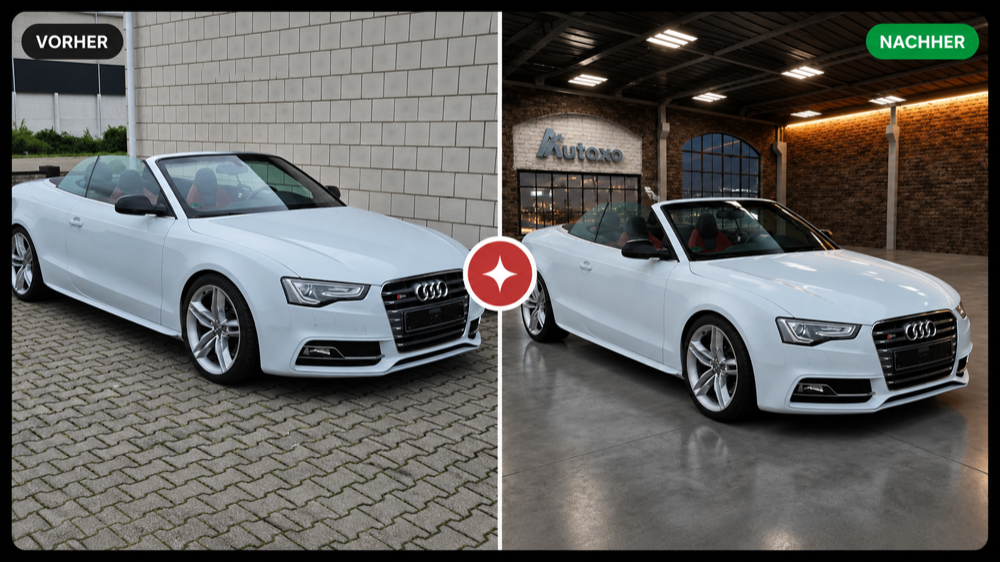
Autaxo Studio primarily addresses the recurring image problems: background, shadows, look, license plates, export, and workflow. The dealer keeps taking the photos, the software handles the standardization.
Vehicle attributes: the underrated partner of your images
Photos generate the click. Attributes make sure the listing shows up in the relevant filters.
If equipment, fuel type, transmission, mileage, VIN-based data, CO₂ information, inspection date (HU), color, accident-free status, number of previous owners, or optional equipment is missing, the listing can lose reach despite good photos.
For dealers, this results in a process rule:
The image workflow and the data workflow must not be separated.
A tool that optimizes photos but does not allow clean assignment to the vehicle record creates disconnected systems. Photos end up in one tool, data in the DMS, listings in the portal, and corrections in emails. That is slow and error-prone.
A better approach is a workflow in which photos are assigned directly to the vehicle and the export to website, DMS, or platform comes from a single consistent data source.
Description: 1,000 characters without filler
As a guideline, mobile.de mentions a detailed description with at least 1,000 characters. The goal is not text volume for its own sake. The goal is to answer buyer questions in advance.
A good description contains:
- a brief classification of the vehicle,
- condition and history,
- relevant equipment,
- maintenance / service,
- special features,
- transparent notes on damage,
- payment and viewing information,
- a clear invitation to get in touch.
Generic text blocks like “very well maintained, available immediately, errors excepted” without substance are bad. Such texts answer no buyer questions and help neither humans nor AI.
The new target process: from vehicle intake to a score-ready listing
A score-ready process does not start in the mobile.de dealer portal. It starts at vehicle intake.
| Process step | Poor workflow | Target workflow 2026 |
|---|---|---|
| Vehicle arrives | DMS entry at some later point | Create the vehicle immediately and generate a photo task |
| Photos | Salesperson shoots by gut feeling | Guided 25-photo checklist |
| Image editing | manual, inconsistent, delayed | AI showroom, license plates, export format |
| Data | Add attributes later | Complete VIN/data fields early |
| Description | short boilerplate text | structured 1,000-character text |
| Quality control | only after complaints | Score and quality check before publication |
| Publication | channel by channel, manually | central export to platforms/DMS |
Autaxo Studio can standardize the image part of this process: photograph the vehicle, optimize with AI, apply a showroom, neutralize license plates, and export for marketing.
7-day sprint: improve the mobile.de image process at your dealership
Day 1: Establish a baseline
Review 20 active listings:
- How many photos do they have?
- How good is the hero image?
- Are there third-party license plates or people?
- Are the interior photos complete?
- Are there vehicles with fewer than 15 photos?
- Are there inconsistent backgrounds?
Day 2: Define the 25-photo standard
Set a binding photo sequence. Post it in detailing, disposition, and sales. Everyone must know which photos are mandatory.
Day 3: Set hero image rules
Define which angle is used as the first photo. For most vehicles, front 45 degrees works very well. What matters is consistency across the inventory.
Day 4: Build in a GDPR check
License plates, faces, documents, and reflections must be checked before publication. If this happens manually, document responsibility and spot checks.
Day 5: Test an AI image workflow
Test one vehicle with Autaxo Studio: upload lot photos, apply a showroom, blur license plates, check the export.
Day 6: Monitor the score and user signals
Compare old and new listings:
- score,
- click-through rate,
- time to first inquiry,
- number of qualified leads,
- rework effort,
- processing time per vehicle.
Day 7: Standardize
What works becomes process. Not a one-off action but a rule: no vehicle goes online with an incomplete photo set.
Measurement plan: how to evaluate the effect properly
A good image process must be measurable. Use at least these metrics:
| KPI | Why it matters | Target direction |
|---|---|---|
| Photos per listing | completeness | increase |
| Share of listings with 25+ photos | mobile.de transparency standard | increase |
| Hero image quality | click impulse | improve |
| Time to market | speed until online | reduce |
| Rework rate | post-processing effort | reduce |
| GDPR hits in QA | process risk | reduce |
| CTR per platform | image impact | increase |
| Time to first inquiry | demand indicator | reduce |
Important: not every better photo automatically leads to a faster sale. But a consistent, complete, fast image process improves the conditions for visibility and conversion.
How Autaxo Studio fits into mobile.de optimization
Autaxo Studio is not just an image filter. It is a workflow tool for marketplace-ready vehicle images.
The key levers:
- smartphone photos taken directly on site,
- AI background removal,
- virtual showroom,
- realistic shadows and reflections,
- license plate blurring,
- a consistent look across the inventory,
- export logic for mobile.de, AutoScout24, website, or DMS,
- API and DMS integration.
This turns “we still need to take photos” into a repeatable process.
Typical mistakes with mobile.de photos
| Mistake | Effect | Better solution |
|---|---|---|
| Too few photos | Buyers have doubts, score potential stays untapped | 25-photo standard |
| Busy lot background | Vehicle appears less premium | virtual showroom |
| Mixed image styles | Inventory looks disorganized | consistent templates |
| Third-party license plates | data protection risk | automatic blurring |
| Hero image with logos/overlays | distraction, possible quality downgrade | clean first photo |
| Missing interior photos | Buyer questions remain open | cockpit and detail standard |
| Damage not shown | loss of trust at the viewing | transparent detail photos |
| Photos going live days later | invisible days in stock | immediate photo task at intake |
Conclusion: the mobile.de score rewards process discipline, not creativity
The Quality Check points in a clear direction: successful listings are complete, visually strong, rich in data, and helpfully described. Dealers who run this process manually and without structure fall behind.
For 2026, the right question is not:
“Who takes good photos here?”
But:
“Which process makes sure that every vehicle goes online quickly, completely, GDPR-compliant, and marketplace-ready?”
Autaxo Studio is one lever for this: smartphone photos from the lot are turned into consistent showroom images, license plates are blurred, and the export into marketing becomes cleaner.
CTA: Test your own mobile.de image workflow with a real vehicle photo: Upload your own vehicle photo
FAQ: mobile.de Quality Check and vehicle photos
What is the mobile.de Quality Check?
The mobile.de Quality Check is an AI-powered tool in the dealer portal. It analyzes listings based on images, number of photos, vehicle data, and description, and provides recommendations for optimization.
How much do photos count in the mobile.de quality score?
According to mobile.de, image quality accounts for 40% of the score and the number of photos for 20%. That means 60% of the score depends directly on the visual presentation.
Are 25 photos mandatory on mobile.de?
mobile.de recommends aiming for at least 25 high-quality photos per listing. Dealers should treat this number as an operational standard, not an occasional extra.
What is the most important photo in a listing?
The hero image, meaning the first photo. In the listing grid, it largely decides the first click. It should show the vehicle clearly, in high quality, and without distracting elements.
Are smartphone photos good enough for mobile.de?
Yes, if the capture process is guided and the photos are then professionally standardized. The bottleneck is usually not the camera but workflow, consistency, and post-processing.
What should a photo app for dealerships be able to do?
It should guide the angles, assign photos to the vehicle, blur license plates, create consistent showroom images, and provide suitable export formats for platforms.
Why are overlays and logos problematic?
mobile.de recommends avoiding distracting information such as logos. Overlays can draw attention away from the vehicle and reduce image quality.
How can Autaxo Studio help?
Autaxo Studio optimizes vehicle photos with AI: removing the background, applying a virtual showroom, neutralizing license plates, standardizing the look, and exporting images for platforms or the DMS.
Read more on Autaxo Studio
- Car photo enhancement with AI
- Photo app for dealerships
- DMS integration for vehicle images
- Days-in-stock/time-to-market calculator
- The GDPR trap in vehicle photos: anonymizing license plates & faces safely
Sources & factual basis
- mobile.de newsroom on the AI-powered listing check: https://newsroom.mobile.de/mobile-de-unterstuetzt-fahrzeughaendler-mit-ki-gestuetztem-inserats-check/
- mobile.de Quality Check info center: https://promo.mobile.de/b2b/wissen/tipps-tricks/qualitaets-check/
- Autaxo Studio car photo enhancement: https://autaxo.studio/en/car-photo-enhancement
- Autaxo Studio photo app for dealerships: https://autaxo.studio/en/dealership-photo-app
- Autaxo Studio DMS integration for vehicle images: https://autaxo.studio/en/dms-integration